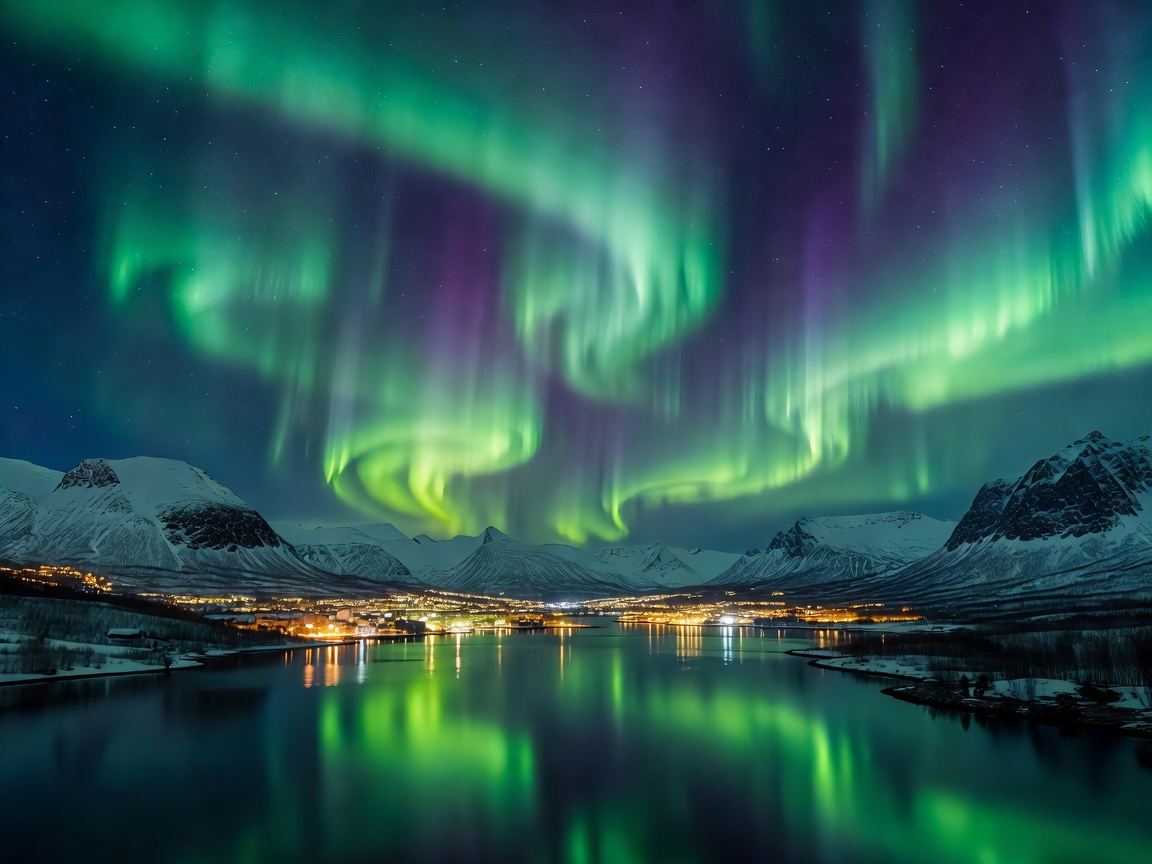
Geographic Advantages & The Auroral Oval
The principal reason Tromsø dominates the aurora pursuit is its positioning inside the maximum statistical band of the auroral oval. Unlike sub-Arctic cities that require substantial solar storms (Kp 4 or higher) to pull displays toward their zenith, observers around Tromsø witness coronal explosions directly overhead even during basal background activity (Kp 1 to 2). When solar wind particles guided by Earth's magnetosphere collide with atomic oxygen at altitudes between 100 and 300 kilometres, the typical 557.7-nanometre green line ignites without requiring rare solar flares.
However, being an island surrounded by maritime fjords, Tromsø experiences volatile coastal weather. A dense marine cloud cover can seal the city bowl while clear skies thrive just forty kilometres inland. Successful observing in Tromsø is not simply about standing still; it is an active discipline of microclimate navigation.
Key Tactical Chasing Corridors
Seasoned polar navigators rely on three distinct geographical axes to outrun cloud fronts moving in from the Norwegian Sea:
- The Inland Lyngen & Skibotn Axis: Heading southeast toward the Finnish border brings observers into the rain shadow of the towering Lyngen Alps. Skibotn is widely regarded as one of Norway's driest inland pockets, frequently featuring cloudless, bone-cold skies while Tromsø city suffers freezing rain.
- Kvaløya & The Outer Coast (Sommarøy): When continental storms push clouds from Sweden and the south, driving west toward Sommarøy can position you on open coastal headlands where localized wind shears rip open large gaps in the cloud ceiling.
- The Signaldalen & Kilpisjärvi Crossing: When coastal fronts refuse to budge, route E8 allows mobile chase teams to cross the border into Kilpisjärvi, Finland. The high tundra plateau sits above marine inversions and offers unobstructed 360-degree horizon visibility.
Field Tip: Urban Vantage vs Wilderness Chasing
While the Fjellheisen Cable Car to Mount Storsteinen (421 metres) offers dramatic panoramas of city lights paired with green skies, urban street lighting creates notable contrast degradation for long-exposure photography. For clean deep-space darks, plan routes at least 25 kilometres outside the municipal perimeter.
Seasonal Dynamics: Autumn vs Mid-Winter
The aurora season spans from late August through mid-April, but atmospheric conditions transform significantly between the quarters:
| Factor | Autumn (Sep – Oct) | Deep Winter (Dec – Jan) | Late Winter (Feb – Mar) |
|---|---|---|---|
| Ground Cover | Unfrozen tundra, dark rock | Deep snowpack, high reflection | Stable crust, polar clarity |
| Fjord Reflections | Superb calm water mirrors | Partially iced shorelines | Ice shelves & snow drifts |
| Temperatures | +4°C to -4°C | -6°C to -22°C inland | -4°C to -18°C |
| Solar Wind Activity | Equinox spikes (Russell-McPherron) | Standard solar cycle variance | Spring Equinox spike |
Equipment Readiness for Arctic Night Conditions
Photographing the aurora around Tromsø requires robust preparation against cold soak. Low temperatures diminish chemical output in camera batteries by up to 60%. Keep spares in an interior jacket pocket close to your chest core. Heavy tripod choice is paramount: coastal wind gusts sweeping across Balsfjorden will induce microscopic camera shake on lightweight carbon travel tripods unless weighted down with rock ballast bags.
Summary: Why Tromsø Remains the Benchmark
Tromsø provides the infrastructure, maritime rescue networks, car rental facilities, and road maintenance needed to operate safely at 69° North. For first-time Arctic travellers, its balance between urban refuge and rapid access to wild sub-zero terrain remains unmatched across Scandinavia.