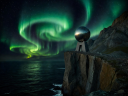
Standing on the Edge of the Arctic Ocean
Located on Magerøya island in Finnmark, the North Cape rises 307 metres vertically above the icy waters of the Arctic Ocean. Unlike any other mainland observation base, there is no terrestrial landmass between the cliff edge and the North Pole. When solar storms trigger auroral curtains over Nordkapp, you are witnessing particles colliding with the upper atmosphere above the high Arctic polar basin.
Because the magnetic midnight occurs early at this extreme latitude, powerful geomagnetic substorms often trigger explosive curtains directly across the northern sky as early as 19:00, continuing well into the early morning hours.
Winter Access: The Convoy Driving Protocol
Reaching the North Cape in deep winter is strictly regulated by the Norwegian Public Roads Administration (Statens vegvesen). Due to extreme Arctic blizzards, fierce winds exceeding 35 metres per second, and complete whiteouts, the final 13-kilometre stretch of the E69 highway from Skarsvåg junction to the plateau is closed to open traffic.
Access is permitted solely via kolonnekjøring (convoy driving). A massive rotary snowplow leads a controlled column of vehicles, flanked by an emergency rescue sweep vehicle at the rear:
- Strict Vehicle Inspection: Every car joining the convoy must have studded winter tyres, full fuel reserves, and adequate clearance. Summer tyres or all-season compounds are strictly prohibited.
- Personal Arctic Gear: Drivers and passengers are required to carry rated sub-zero outerwear, thermal boots, shovel, tow cables, and extra emergency rations in case the convoy becomes trapped by a sudden snow avalanche.
- Fixed Departure Windows: Convoys operate under strict timetables, typically departing once or twice daily, weather permitting. If wind speeds surpass safety thresholds, convoys are cancelled without notice.
Base of Operations: Honningsvåg
Most expedition teams base themselves in Honningsvåg, the nearest town on Magerøya island. Honningsvåg offers sheltered port accommodation, maritime supplies, and fuel facilities thirty kilometres south of the extreme plateau.
Atmospheric & Photography Challenges at 71° North
Nordkapp presents some of the most aggressive environmental challenges in Europe. The high plateau experiences constant gale-force maritime winds that sweep off the Arctic Ocean unimpeded by trees or hills. Setting up a tripod at the Globe Monument demands heavy rock anchors or ice screw moorings. Furthermore, polar ocean spray carried in gale winds can create sea-salt frost on front lens elements within minutes.
| Expedition Element | North Cape Plateau | Standard Arctic City (Tromsø) |
|---|---|---|
| Latitude | 71°10′21″ N (Europe’s Extreme) | 69°39′07″ N |
| Wind Exposure | Severe open ocean plateau gale risk | Sheltered fjord microclimates |
| Access Feasibility | Controlled convoy dependent on plows | Paved multi-lane highways & city streets |
| Light Contamination | Total darkness over northern ocean | Substantial city ambient illumination |
The Polar Night Experience
At 71° North, the polar night is prolonged and profound. The sun sinks below the horizon in mid-November and does not reappear until late January. During the heart of this period, the midday hours offer only a deep indigo twilight. This extensive darkness broadens the statistical viewing window to over 20 hours per day. Observers frequently witness daytime aurora displays caused by the direct cusp entry of solar wind particles.
Summary
The North Cape is not a casual evening excursion; it is a genuine Arctic milestone. For travellers willing to navigate convoy schedules, sub-zero wind chills, and raw polar isolation, watching the green and magenta curtains swirl above the steel Globe monument remains the pinnacle of northern lights exploration.