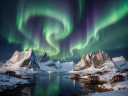
The Visual Drama of the Lofoten Wall
While inland Arctic areas often present vast flat plains of snow-covered birch, the Lofoten archipelago (Lofotveggen) is an ancient, glacier-carved mountain barrier stretching over 100 kilometres into the Atlantic. At approximately 68°N, it lies comfortably within the auroral zone, ensuring that any moderate magnetospheric substorm ignites the sky overhead.
The defining appeal of Lofoten is compositional depth. A photographer or observer is rarely looking into empty darkness. Instead, auroral arcs cast an emerald or violet glaze across crashing shore breaks, icy sea rocks, and steep granite faces that rise 800 to 1,000 metres directly out of the Norwegian Sea.
Dual Seasonal Splendour: Polar Night and Midnight Sun
Lofoten is globally famed for its light phenomena at both extremes of the celestial calendar. During the winter polar night (early December through mid-January), the sun does not crest the horizon, leaving a world of lingering sapphire twilights that give way to 18 hours of pitch darkness—the ultimate canvas for auroral displays.
Conversely, during the summer months (late May through mid-July), Lofoten experiences continuous daylight beneath the famous midnight sun. Travellers who explore Lofoten during the transitional equinox windows (September and March) witness the crossover: golden Arctic sunsets that linger for hours, seamlessly transitioning into night skies alive with dancing northern lights.
Top Aurora Observation Locations Across the Archipelago
Selecting an observation base in Lofoten depends on wind direction, tide height, and swell size:
- Haukland and Uttakleiv Beaches (Vestvågøy): Facing directly toward the open northern ocean, Uttakleiv is celebrated for its sculpted boulders and zero light pollution. Haukland boasts white Arctic sands that capture green auroral reflections on retreating tide water.
- Reine and Hamnøy (Moskenes): The quintessential postcard view of Norway. Positioned along the Reinefjord, the sheer wall of Olstind towers above stilt-supported wooden cabins. Auroral arcs arching over Reinefjorden provide world-class photographic depth.
- Skagsanden Beach (Flakstad): Known for black mineral sand patterns intertwining with golden sands, Skagsanden provides expansive northern horizons with the jagged peak of Hustinden framing the eastern flank.
| Feature | Lofoten Islands | Inland Arctic (e.g. Alta) |
|---|---|---|
| Foreground Scenery | Ocean surf, sea stacks, jagged alpine spires | Pine forests, rolling plateaus, frozen river valleys |
| Winter Climate | Maritime temperate (-2°C to +3°C, humid) | Continental Arctic (-12°C to -30°C, dry) |
| Cloud Mobility | Rapid coastal changes, shifting squalls | Stable weather systems, slower clearance |
| Driving Hazards | Black ice, coastal crosswinds, narrow bridges | Drifting packed snow, extreme deep freeze |
Navigating Coastal Weather Challenges
The Gulf Stream keeps Lofoten significantly warmer than continental Finnmark at identical latitudes. However, maritime conditions bring moisture. Snow squalls can envelope an island in near-zero visibility for forty minutes before dissipating into crystalline calm. Navigators must monitor live radar loops rather than static 24-hour forecasts. The key rule of Lofoten aurora hunting is patience: never abandon a location early simply because a passing Atlantic cloud shower sweeps across your vantage.
Logistics and Field Safety
Winter roads across the E10 artery are narrow, flanked by sea drops and steep snowbanks. Vehicles must be equipped with studded winter tires (piggdekk) and survival gear including tow straps, reflective vests, and microspikes for negotiating icy beach rocks. Tide awareness is equally crucial: incoming Arctic surges on beaches like Uttakleiv can sweep unwary observers off icy boulders in sub-zero darkness.